2026 NEWS 2026

2026 Consulting, Research and Professional Association Activities

Summary: Continued consulting, research and papers relating to delivery of complex infrastructure projects worldwide related to risk, contracting and delivery methods and tunnel boring machine procurement. Presentations and Participation at the ITA Tunneling Conference Montreal with contributions to Working Groups 2 (risk) and 3 (contracting and delivery).

Consulting: Advisory services re risk management for the $20 billion Delta Conveyance Program near Sacramento California. Review of risk management plans and procedures, risk registers and implementation of a probabilistic cost and schedule process.

Research: With colleagues at the University of Munich, a paper addressing the evolution of contract and delivery processes developed over the past 30 years which, in general, have moved from fixed-price hard money contracting to more inclusive, flexible, collaborative methods with incentive fee provisions. Presented at the ITA Conference, Montreal and the North American Tunneling Conference, Anaheim CA.

ITA TBM Procurement Guideline: John edited the initial Chapters of the ITA “Guideline on the Procurement of Tunnel Boring Machines”, which draws significantly from his papers on this topic, printed in TunnelTalk in 2020 and 2021 (link to these papers on the HOME page). This includes recommendations regarding who should choose the machine – owner, consultant or contractor – and a suggested process to increase the drive capability of a TBM, additional cost to be justified by a risk/benefit analysis. The Guideline is being developed jointly by ITA Working Groups 3 and 14.

ITA Risk Management Guideline: Input to, and review of, a new guideline for management of risk, including management of cost and schedule, for complex infrastructure programs, including use of probable cost and schedule projections and digital-twin methodologies.
2026 Research and Professional Development

Megaproject Contracting and Delivery, Comprehensive Report/Thesis:

John continues to collaborate with colleagues at the University of Munich regarding advanced contracting and delivery methods for complex urban infrastructure programs. This builds on work over the last 25 years and previous papers on this topic.

The concept is to define a structured process to determine and quantify what is most important to owners, designers, contractors and other stakeholders and to use these priorities to define and determine the appropriate contractual structure, considering these factors and optimal outcomes. This research may be elevated to a comprehensive thesis at the University of Munich.

An initial paper will be presented at the International Tunneling Association (ITA) in Montreal and the North American Tunneling Conference in California this year.(see following abstract).

Abstract: Advanced Contracting and Delivery for Complex Infrastructure Programs

The ability of an owner to define risk ownership through contractual methods is fraught with uncertainty related to the risk management methodology used, the response of the contractor to the bid environment and uncertain ground conditions. Risk management processes and contractual methods are a key determinants to outcomes.

Additionally, conflicts in complex underground projects arise from inequitable contractual and risk provisions and frameworks. Contracts should balance owner and contractor needs and use advanced risk management and sharing, while related bonding and insurance availability issues may limit contractors who will bid. Additionally, fixed-price contracts do not address the uncertainty of underground works, often leading to changes, claims, disputes and litigation.

This paper presents a collaborative contracting method which addresses needs of owners and contractors, within a structured risk-based environment.  It details a structure tailored to the specific conditions of a project, and presents successful results, as applied to major projects in Europe.

International Tunneling Association (ITA)

ITA Working Group 3 (in association with WG14) is preparing a guideline for the selection and procurement of Tunnel Boring Machines. This work has been informed by John’s papers and presentations over the last 30 years on this topic, so John was asked to edit the initial chapters of the guideline, which is currently under final peer review.

You can download the predecessor articles from 2011, 2021 and 2020 which were published in the on-line publication, “TunnelTalk”, by clicking the following links:[ TBM Procurement and Contractual Processes, 2021 ]  [ TBM Procurement, Risk and Technology Advancement, 2020 ].[ Alternative Contracting, 2011 ].  The initial article, given in 1997 at the Vienna ITA Conference is available by contacting John.

The current ITA WG3 initiative will define implementation of a recommended international risk-based cost estimating process for ITA, building on the WSDOT Cost Estimate Validation Process (CEVP) process which John developed with WSDOT in 2002, and will include the experience of other WG members.  Also related to WG2 initiatives regarding risk.

ITA Working Group WG20 “Urban Problems/Underground Solutions” (which John initiated in 2002) is finalizing a report regarding the choice between one large tunnel/TBM vs. two smaller tunnels for rail, transit and highway projects. John contributed to the WG20 report which is under final review.

2025 Consulting, Research and Professional Association Activities

Another busy year with limited consulting, research and papers relating to delivery of complex infrastructure projects worldwide. The year started with a presentation at the UCA Fox Conference in New York City, tracing the development of advanced collaborative contracting practices over the last 30 years including Alliancing, Progressive Design-Build- and related approaches such as Project 13 (UK) and Progressive Partnering (Europe)

Consulting: included assignments with HNTB including risk analysis of the probable effect on adjacent structures of the very large tunnel boring machine for the BART extension to San Jose; risk related to movements of a 100 year old tunnel for a light rail line in San Francisco, and consideration of tunnel alternatives for replacement of the Tobin bridge in Boston.

Research, Upcoming Papers 2026: With colleagues at the University of Munich, a paper addressing the evolution of various contract and delivery processes developed over the past 30 years which, in general, have moved from fixed-price hard money contracting to more inclusive, flexible and collaborative methods – with the potential to better control cost exposure for owners and increase profits for contractors. The paper will give specifics of current and developing methodologies and will describe implementation for underground projects in Europe – processes and outcomes

International Tunneling Association: John is contributing to a report of ITA Working Group 20 (which he initiated in 2002) on the choice between one very large Tunnel/TBM or two smaller tunnels. This topic is relevant as the size and capability of Tunnel Boring Machines now routinely meets or exceeds the size of the Alaskan Way Project TBM in Seattle (57.5 feet / 17.5 meters) which John worked on.

John is also editing the initial Chapters of the ITA “Guideline on the Procurement of Tunnel Boring Machines”, which draws significantly from his papers on this topic, printed in TunnelTalk in 2020 and 2021 (link to these papers on the HOME page). This includes recommendations regarding who should choose the machine – owner, consultant or contractor – and a suggested process to increase the drive capability of the TBM, cost to be justified by a risk/benefit analysis. The Guideline is being developed by ITA Working Groups 3 and 14.

Report: Joint Cooperation, Technology Development, Application of TBMs

The following message was sent to Jenny Yan, President of the Chinese Tunnelling and Underground Works Society and Past-President of the International Tunneling Association following the very successful recent Tunneling Conference in Shenzhen China, marking the 50th anniversary of the International Tunneling Association.

Jenny – on the occasion of your very successful ITA 2024 Conference in Shenzhen, and the 50th anniversary of ITA I looked back at the work we did in 2000 and 2001 regarding implementation of mechanized tunneling and joint manufacture of TBMs in China. The results of TBM implementation in China since that time are truly impressive, with many machines working at advanced levels. The high-level 2001 TBM report was extensive in its content and guidance for the future of mechanized tunneling in China.

I am very appreciative of the work of my co-authors – Piergiorgio Grasso, Shulin Xu and Gianni Arrigoni– for their contributions to the report and tunneling world-wide. Thank you!

Background to the 2001 High-Level Report:
Following an address on Tunneling and Megaproject delivery that I gave in Beijing in 2000, I was asked by one of the very senior Chinese engineers, Mr. Han, if he could talk to me about the future of tunnelling in China. I asked my colleague Gianni Arrigoni to come, with his colleague Mai Zie to translate. We subsequently found that Mr. Han had studied in Moscow with Li Peng (Former Premier of the People’s Republic of China) and thus was quite influential in China.  He had worked to introduce mechanized tunnelling to China for several years but with limited success.  He asked if I could write a high-level report which would help the Chinese to understand the need for advanced mechanical excavation, the use of tunnel boring machines and to expand tunneling capacity in China.

I then asked Piergiorgio Grasso and Xu Shulin, with Gianni, to help with the report.  We completed the report and sent it to our colleague, Professor Fu, for review and publication.  After some time had passed (during which an incomplete translation was corrected), it was published in the Chinese Journal Modern Tunneling Technology Vol. 39 February 2002.

Subsequently Prof. Fu asked me to organize a symposium in Beijing in 2002 so that TBM manufacturers around the world could come to Beijing to meet with their Chinese counterparts – to discuss joint cooperation and tunnel boring machine manufacture in China.  We were successful in getting most of the manufacturers to attend and for them to develop formal relationships with Chinese manufacturers.  The result has been that now there is a very significant capability for tunnel boring machine manufacturing in China, of good quality, with many machines operating in China (almost equal to all TBMs operating in the world today). China is now exporting advanced machines to other countries.

Quite a story.  At the end of the 2002 symposium, that night, on TV, I saw the images from New York of the 9/11 planes hitting the twin towers.  Next day, my Chinese colleagues told me “….you are welcome to stay in Beijing as our guest, you will be safe here”. They also said: “…this is a concern for everyone, we must work together to resolve this”. Sadly, such good intentions were not fully realized.

A current note: In listening to the former ITA presidents speak at the ITA Open Session in Shenzhen, it was clear that we can work together cooperatively, in the development of underground space and facilities, and that person-to-person contacts and relationships are essential. I have been fortunate to have such relationships with international colleagues, ITA Presidents, Executive Board and Working Group members, since 1993. For that I am truly grateful.

Presentation to the International Construction Management Association Conference, June 24-25, 2024, New York / New Jersey

John attended this International Construction conference and presented a topic which included megaproject delivery, risk and risk management, contracting methods and success factors. There was good discussion on these topics and follow-on with colleagues in Germany and Austria. Some of these advanced themes are now being discussed on John’s projects in Massachusetts, California, Washington State and Georgia.

Senior Program Management Review

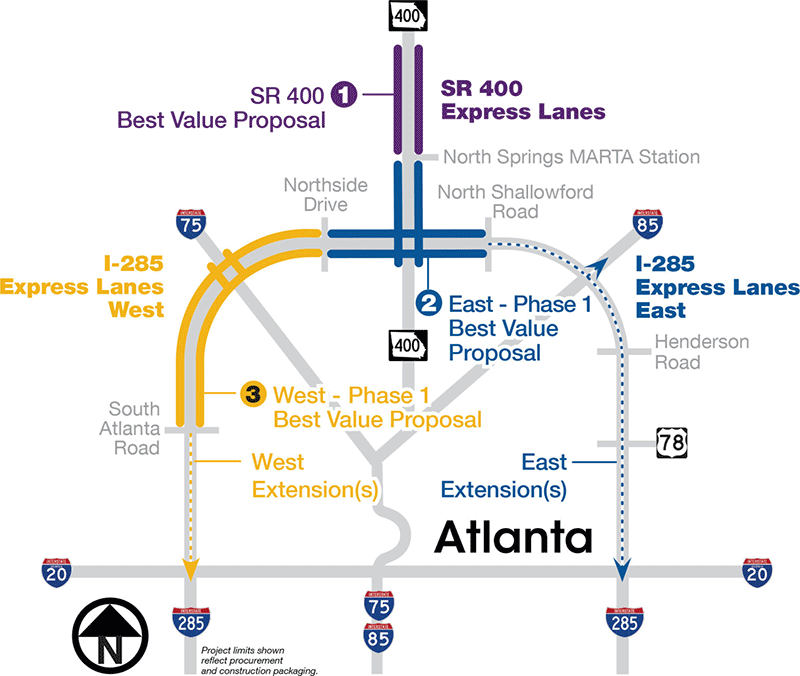
HNTB has a contract to provide Program Management services for the multi-billion-dollar Georgia Highway Program. John reviewed the Program Management Office’s leadership, organization, structure, guidance documents, implementation of contracting (multiple methods), risk management and team-alignment. He interviewed senior management and documented responses by key categories – related to success factors – and developed recommendations from his work on comparable megaprojects.

I-285 EL Proposal and Segments

Image Credit: Georgia Department of Transportation

Subsequent to the report, which was very well received, he has advanced an understanding of megaproject success and failure factors. He is working with the PMO office to advance this understanding and apply it to the program – to identify what is working well and which areas or processes need improvement.